Every recording, on a timeline
Search by title, singer, or genre, and use the year range above to narrow the window. Click any dot to play it.
Nothing matches your filters.
Recordings per year
How much they recorded, year by year, split by genre, or by vocal versus instrumental.
Singers & instrumentals
Each row is a singer; every block a year they recorded. Darker blocks = more recordings that year. Click a block for that year, or a singer's name for everything they sang.
From the leader's own pen
Tangos the orchestra recorded that its leader also composed.
Singers & musicians
Everyone who recorded or played with the orchestra. Each card links to their page, so you can follow a singer or player to the other orchestras they featured in.
Eras and lineups
Who was in the band, and when. Each era joins to the recordings tagged to it, so lineups the corpus can't name are added over time.
Era and lineup research by Todo Tango. Endless gratitude to them for documenting who played in each orchestra, and for sharing it so generously. Go explore their wonderful work.
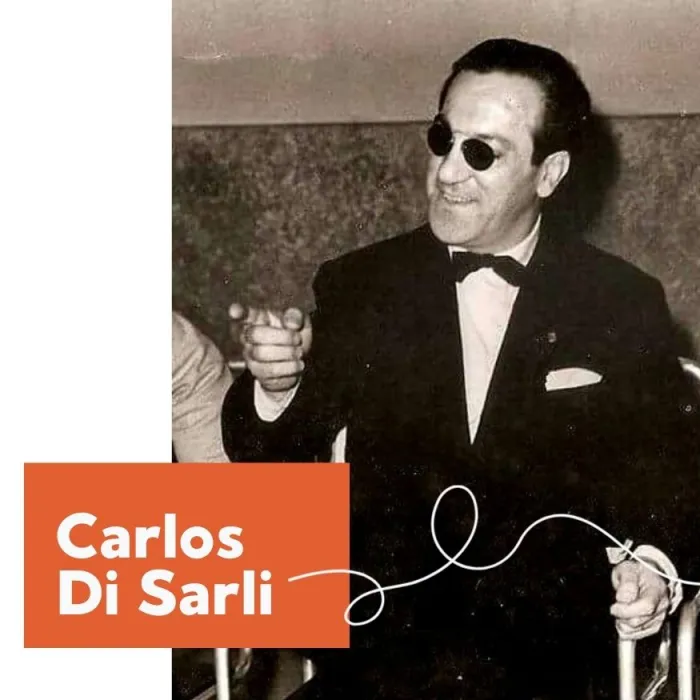
Led throughout by Carlos Di Sarli on piano. Each era below is a chapter of the orchestra's lineup. The ones still marked as not documented are waiting to be filled in.
- 1928–1931
The sextet
49 recordings2 bandoneón2 violín1 piano1 bassDi Sarli's early sextets, which recorded 48 numbers between 1928 and 1931. Roberto Guisado, the violinist who would concertmaster the orchestra for decades, and bassist Domingo Capurro were already at his side. Under contract to Victor, he also secretly backed Mercedes Carné and Tania on rival labels, uncredited.
- César Ginzo bandoneón
- Tito Landó bandoneón
- Ricardo Gargiulo bandoneón Replaced Landó in 1930.
- Roberto Guisado violin
- José Pécora violin
- David Abramsky violin
- Héctor Lefalle violin Replaced Abramsky.
- Adolfo Muzzi violin
- Félix Verdi bandoneón Joined in 1932, a fixture for decades.
- Adolfo Krauss double bass
- Domingo Capurro double bass Replaced Krauss; stayed into the 1940s.
- 1928-11-26 The first sextet recordings; 48 numbers followed through August 1931.
- 1939–1941
The first típica, Rufino's voice
46 recordings3 bandoneón3 violín1 piano1 bassDi Sarli formed his own orchestra in 1938 and, in December 1939, cut its first two tangos, "Corazón" and "Retirao". Roberto Rufino, the young singer who defined the early orchestra, replaced Ignacio Murillo in 1939.
- Roberto Guisado violin
- Ángel Goicoechea violin
- Alfredo Pérez violin
- Antonio Rossi violin Added in 1940.
- Roberto Gianitelli bandoneón
- Domingo Sánchez bandoneón
- Roberto Mititieri bandoneón
- Félix Verdi bandoneón From 1940.
- Luis Porcell bandoneón From 1940.
- Domingo Capurro double bass
- 1939-12 Corazón / Retirao The orchestra's first two recordings.
- 1942–1943
Five violins
49 recordings5 bandoneón5 violín1 piano1 bassThe section widened to five violins, deepening the lush, unhurried Di Sarli sweep. Roberto Rufino sang, and in 1942 Alberto Podestá joined him.
- Roberto Guisado violin
- Ángel Goicoechea violin
- Alfredo Pérez violin
- Antonio Rossi violin
- Claudio González violin
- Félix Verdi bandoneón
- Domingo Sánchez bandoneón
- Roberto Gianitelli bandoneón
- Roberto Mititieri bandoneón
- Luis Porcell bandoneón
- Domingo Capurro double bass
- 1944–1945
A leaner orchestra
35 recordings3 bandoneón4 violín1 piano1 bassA trimmer lineup for the mid-forties. Alberto Podestá carried the vocals, and in 1945 Jorge Durán, who would record more with Di Sarli than anyone but Rufino, joined.
- Roberto Guisado violin
- Ángel Goicoechea violin
- Alfredo Pérez violin
- Antonio Rossi violin
- Félix Verdi bandoneón
- Domingo Sánchez bandoneón
- Federico Scorticati bandoneón
- Domingo Capurro double bass
- 1945 Jorge Durán joined on vocals.
- 1946–1948
Greco on bass, before the pause
26 recordings4 bandoneón4 violín1 piano1 bassÁngel Ramos and a returning Roberto Mititieri filled out the bandoneóns while Hamlet Greco took over the bass. In 1947 the young Leopoldo Federico replaced Félix Verdi; in 1949 Di Sarli dissolved the orchestra and stepped away into the real-estate business.
- Roberto Guisado violin
- Ángel Goicoechea violin
- Alfredo Pérez violin
- Antonio Rossi violin
- Domingo Sánchez bandoneón
- Roberto Mititieri bandoneón
- Ángel Ramos bandoneón
- Leopoldo Federico bandoneón Replaced Verdi in 1947.
- Hamlet Greco double bass Replaced Capurro.
- 1949 Di Sarli dissolved the orchestra and turned to real estate.
- 1951–1954
The Music Hall return
84 recordings5 bandoneón6 violín1 piano1 bassDi Sarli resumed his orchestra in 1951, the first in Argentina to release its new recordings on vinyl. Oscar Serpa and Mario Pomar sang. Roberto Guisado again led a six-violin section.
- Roberto Guisado violin
- Bernardo Weber violin
- Ángel Goicoechea violin
- Simón Bajour violin
- Claudio González violin
- Alfredo Pérez violin
- Félix Verdi bandoneón
- Federico Scorticati bandoneón
- Ángel Ramos bandoneón
- Luis Masturini bandoneón
- Juan Carlos Matino bandoneón
- Alfredo Sciarretta double bass
- 1951 Di Sarli resumed recording; the first Argentine orchestra to issue new sides on vinyl.
- 1954–1956
The Victor years
33 recordings4 bandoneón5 violín1 piano1 bassThe Victor period, with Elvino Vardaro among the violins and a bandoneón line led by José Libertella and Julián Plaza. Rodolfo Galé and Argentino Ledesma sang; Jorge Durán returned in 1957.
- Simón Bajour violin
- Elvino Vardaro violin
- Elías Slon violin
- Alfredo Rouco violin
- Antonio Rossi violin
- José Libertella bandoneón
- Julián Plaza bandoneón
- Alfredo Marcucci bandoneón
- Domingo Sánchez bandoneón
- Alfredo Sciarretta double bass
- 1956–1958
A brand-new orchestra
36 recordings5 bandoneón8 violín1 piano1 bassA large, brilliant orchestra with an eight-strong violin section, Roberto Guisado once more at its head. Horacio Casares and Jorge Durán sang.
- Roberto Guisado violin
- Elvino Vardaro violin
- Alfredo Rouco violin
- Simón Bajour violin
- Carlos Arnaiz violin
- Claudio González violin
- Antonio Rossi violin
- Juan Schiaffino violin
- Félix Verdi bandoneón
- José Libertella bandoneón
- Julián Plaza bandoneón
- Alfredo Marcucci bandoneón
- Domingo Sánchez bandoneón
- Alfredo Sciarretta double bass
- 1958–1960
The final lineup
20 recordings5 bandoneón4 violín1 piano1 bassDi Sarli's last recordings, for Philips, cut instrumentally and overdubbed with the voices of Jorge Durán and Horacio Casares. After his death in 1960 the label replaced four Durán vocals with Edmundo Rivero, who was never a member, a commercial trick.
- Roberto Guisado violin
- Elvino Vardaro violin
- Simón Bajour violin
- Antonio Rossi violin
- Félix Verdi bandoneón
- José Libertella bandoneón
- Julián Plaza bandoneón
- Alfredo Marcucci bandoneón
- Domingo Sánchez bandoneón
- Alfredo Sciarretta double bass
- 1958-11 Di Sarli's last recordings; his total from 1939 was 382 numbers.
- 1928–1956
Unassigned
28 recordingsThese recordings aren't sorted into an era yet.