Every recording, on a timeline
Search by title, singer, or genre, and use the year range above to narrow the window. Click any dot to play it.
Nothing matches your filters.
Recordings per year
How much they recorded, year by year, split by genre, or by vocal versus instrumental.
Singers & instrumentals
Each row is a singer; every block a year they recorded. Darker blocks = more recordings that year. Click a block for that year, or a singer's name for everything they sang.
From the leader's own pen
Tangos the orchestra recorded that its leader also composed.
Singers & musicians
Everyone who recorded or played with the orchestra. Each card links to their page, so you can follow a singer or player to the other orchestras they featured in.
Eras and lineups
Who was in the band, and when. Each era joins to the recordings tagged to it, so lineups the corpus can't name are added over time.
Era and lineup research by Todo Tango. Endless gratitude to them for documenting who played in each orchestra, and for sharing it so generously. Go explore their wonderful work.
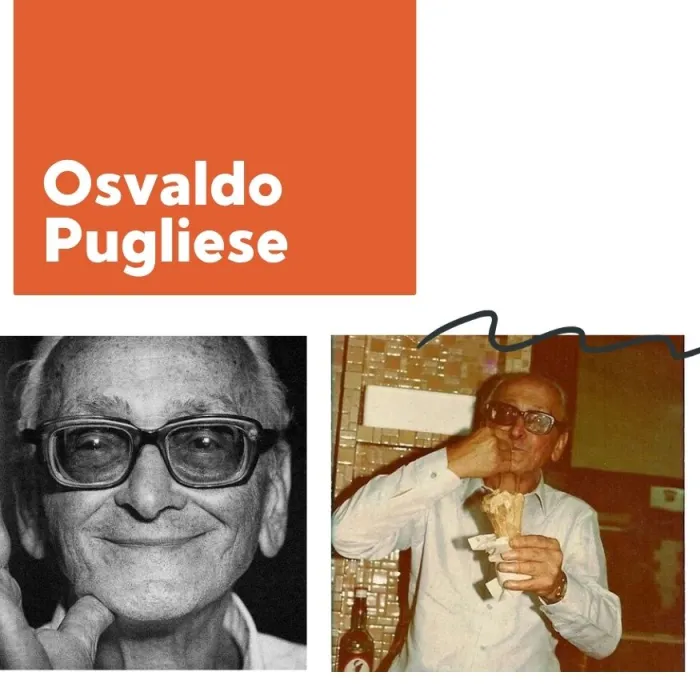
Led throughout by Osvaldo Pugliese on piano. Each era below is a chapter of the orchestra's lineup. The ones still marked as not documented are waiting to be filled in.
- 1929–1938
Antecedents: the Vardaro-Pugliese sextet
Before his own orchestra, Pugliese co-led the celebrated Vardaro-Pugliese sextet and the Pugliese-Gobbi quintet, and made several attempts at a band of his own. These groups predate his recordings, but they seeded the personnel: a sixteen-year-old Aníbal Troilo passed through, and Aniceto Rossi took the bass chair he would hold for decades.
- Elvino Vardaro violin Co-led the 1929-30 Vardaro-Pugliese sextet.
- Aníbal Troilo bandoneón In the 1930 sextet, aged sixteen.
- Alfredo Gobbi violin Co-led the Pugliese-Gobbi quintet, 1931.
- Ciriaco Ortiz bandoneón In the 1930 sextet.
- Alfredo De Franco bandoneón
- Marcos Madrigal bandoneón In the 1936 orchestra attempt.
- Aniceto Rossi double bass From 1936, the bass chair he held into the 1960s.
- 1939 Pugliese consolidated his own orchestra, with Alessio, Ruggiero and Camerano; singers Amadeo Mandarino and Roberto Beltrán.
- 1943–1946
Recording debut, before La Yumba
51 recordings4 bandoneón4 violín1 piano1 bassThe first recording years. Osvaldo Ruggiero, who would anchor the bandoneóns for decades, was already in place, and the singers Roberto Chanel and, from 1944, Alberto Morán gave the young orchestra its voice.
- Enrique Alessio bandoneón First bandoneón of the early orchestra.
- Osvaldo Ruggiero bandoneón
- Esteban Gilardi bandoneón
- Alberto Armengol bandoneón
- Oscar Castagniaro bandoneón
- Enrique Camerano violin
- Julio Carrasco violin
- Jaime Tursky violin
- Oscar Herrero violin
- Aniceto Rossi double bass
- 1946–1951
La Yumba and the Pugliesean style
59 recordings4 bandoneón4 violín1 piano1 bass"La Yumba" (1946) crystallized the pounding, dramatic style that became unmistakably Pugliese. Alberto Morán was its emblematic voice, and Emilio Balcarce, a future arranger and leader, joined the violins in 1948.
- Osvaldo Ruggiero bandoneón
- Jorge Caldara bandoneón
- Esteban Gilardi bandoneón
- Oscar Castagniaro bandoneón
- Enrique Camerano violin
- Oscar Herrero violin
- Emilio Balcarce violin Joined in 1948; later an arranger and leader.
- Julio Carrasco violin
- Aniceto Rossi double bass
- 1946 La Yumba The recording that named the Pugliese sound.
- 1951–1960
The mature sound
115 recordings4 bandoneón4 violín1 piano1 viola1 cello1 bassThe orchestra's classic decade, with Ruggiero leading a deep bandoneón section and a string quartet (viola and cello added). Jorge Maciel became the great voice of the mature era from 1954. Osvaldo Manzi stood in on piano for some months in 1957.
- Osvaldo Ruggiero bandoneón
- Jorge Caldara bandoneón
- Esteban Gilardi bandoneón
- Roberto Peppe bandoneón Died in November 1955.
- Mario Demarco bandoneón
- Ismael Spitalnik bandoneón
- Víctor Lavallén bandoneón
- Julián Plaza bandoneón Also an arranger.
- Enrique Camerano violin
- Oscar Herrero violin
- Emilio Balcarce violin
- Julio Carrasco violin
- Simón Bajour violin Joined in 1959.
- Francisco Sanmartino viola
- Norberto Bernasconi viola From 1957.
- Adriano Fanelli cello Added in 1959.
- Aniceto Rossi double bass
- 1954 Jorge Maciel joined on vocals, replacing Alberto Morán.
- 1960–1961
The Stentor sides
11 recordings4 bandoneón3 violín1 piano1 viola1 cello1 bassA brief spell on the Stentor label. Arturo Penón joined the bandoneóns, and Alcides Rossi, Aniceto's son, took over the bass from his father.
- Osvaldo Ruggiero bandoneón
- Víctor Lavallén bandoneón
- Julián Plaza bandoneón
- Arturo Penón bandoneón
- Oscar Herrero violin
- Emilio Balcarce violin
- Julio Carrasco violin
- Norberto Bernasconi viola
- Adriano Fanelli cello
- Alcides Rossi double bass Aniceto Rossi's son.
- 1961–1968
The Philips years
88 recordings4 bandoneón3 violín1 piano1 viola1 cello1 bassAfter the acclaimed 1959 tour of the Soviet Union, the orchestra settled into its Philips period. Jorge Maciel and, from 1964, Abel Córdoba, who would sing with Pugliese to the end, carried the vocals.
- Osvaldo Ruggiero bandoneón
- Víctor Lavallén bandoneón
- Julián Plaza bandoneón
- Arturo Penón bandoneón
- Oscar Herrero violin
- Emilio Balcarce violin
- Julio Carrasco violin
- Raúl Domínguez violin From 1966.
- Mauricio Marcelli violin From 1966.
- Claudio González violin From 1966.
- Norberto Bernasconi viola
- Enrique Lannoo cello From 1964.
- Alcides Rossi double bass
- 1964 Abel Córdoba joined on vocals, the voice of Pugliese's later decades.
- 1969–1990
The final orchestra
147 recordings4 bandoneón3 violín1 piano1 viola1 cello1 bassA sweeping renewal in 1969 brought in a younger generation, some of whom (Rodolfo Mederos, Juan José Mosalini, Daniel Binelli, Héctor Del Curto) became major figures in their own right. Abel Córdoba remained the constant voice, and Alejandro Prevignano and violist Merei Brain served for decades, through to the last lineup in 1995.
- Arturo Penón bandoneón
- Daniel Binelli bandoneón
- Juan José Mosalini bandoneón
- Rodolfo Mederos bandoneón
- Alejandro Prevignano bandoneón Long-serving, into the 1990s.
- Roberto Álvarez bandoneón
- Fabio Lapinta bandoneón
- Walther Castro bandoneón
- Héctor Del Curto bandoneón Later renowned internationally.
- Mauricio Marcelli violin
- Raúl Domínguez violin
- Santiago Kutchevasky violin
- Osvaldo Monterde violin
- Diego Lerendegui violin
- Merei Brain viola Served on viola into the 1990s.
- Pedro Vidaurre cello
- Patricio Villarejo cello
- Fernando Romano double bass
- Ángel Bonura double bass In the final 1995 lineup.
- 1969 A wholesale renewal brought in Binelli, Mosalini and Mederos.
- 1995 The last lineup, still with Abel Córdoba on vocals.
- 1944–1992
Unassigned
35 recordingsThese recordings aren't sorted into an era yet.